Hi, I’m Rhoni.
I’m a psychotherapist providing virtual therapy to adults across Washington State. I’m also currently completing additional training in sex therapy, an area of this work I’m especially excited to continue developing.
I want you to experience me as a real person in the therapy room. I think of myself as curious, down-to-earth, and genuinely interested in getting to know the person in front of me. I take this work seriously, but I don’t believe therapy always has to feel serious. There can be room for depth and vulnerability alongside laughter, awkward moments, silence, big feelings, and all the ordinary messiness of being human.
I don’t pretend to have everything figured out just because I’m sitting in the therapist’s chair. In fact, some of my own experiences are part of what led me here.
If you’re curious about how I came to this work, here’s a little more of my story.
My Why
I have had my fair share of mental health experiences. I struggled with anxiety and depression for a very long time, and I'm also neurodivergent and identify as a highly sensitive person (HSP), but I didn't understand these things about myself. Instead, I spent years trying to make sense of why my brain seemed to make some things harder for me than they appeared to be for other people. I was told I was “too sensitive” or “too much”; I cried easily and often felt different from the people around me. I often got the message that my emotions made other people uncomfortable. I struggled in school, struggled with myself, and wondered why I wasn't “normal” or “good enough.” For far too long, I saw these parts of myself as bad, flawed, or inherently wrong.
Those struggles eventually led me toward my own healing. In particular, I was fortunate to have one incredible therapist who helped me understand myself differently and showed me just how powerful a therapeutic relationship can be. I share this because I want you to know that I understand some of what it's like to sit on the other side of the room, to bring in things you're ashamed of, confused by, or haven't quite found words for yet, and to slowly discover that you don't have to carry all of it alone. Therapy and medication have both been important parts of my healing, while also teaching me that there isn't one right path toward feeling better.
As I became healthier and began to understand myself in ways I hadn't before, I found myself wanting to help other people find their own way toward healing, too. I eventually became a victim advocate working with survivors of sexual assault, and that work deepened my understanding of the courage it can take to ask for help and speak painful truths. Ultimately, it was through that work that I realized not only that I wanted to become a therapist, but that maybe I really was “good enough” to become one. So I took a brave step and applied to graduate school. Now I'm here.
The relationship I had with my therapist is a big part of why the relationship between therapist and client matters so much to me. She helped shape my idea of the kind of therapist I hope to be for others. Through my experiences with her, I learned that being seen, believed, and cared for in a safe relationship can be healing in itself, especially when the world outside that relationship has not always felt safe.
I also learned that those parts of myself I had thought were bad, the emotional parts, the fearful parts, could actually be listened to. They weren't things I needed to get rid of. They had served a purpose, and I could learn to understand them and eventually even embrace them.
I want therapy to be a place where you don't have to have everything figured out or rush difficult emotions away. I want there to be room for you to be where you are, who you are, and hopefully feel a little less alone while we figure things out together. I don't believe there's one right way to heal, but I do believe that when the right people find each other and the relationship feels safe enough, therapy can sometimes feel a little like magic.
My experiences inform how I show up as a therapist, but ultimately, therapy is your space. I won't assume that what helped me will help you, or that sharing an identity, diagnosis, or experience means our stories are the same. You are unique. You don't need to be fixed. And I'm glad you're here.
Areas of Special Interest
I’m especially drawn to working with self-reflective people who feel and think deeply and want to understand themselves beyond the surface. Areas of particular interest include women’s experiences, trauma and shame, relationship patterns, intimacy and sexuality, body image, identity, and the complicated ways past experiences continue to show up in the present.
I also care deeply about creating therapy that feels affirming, respectful, and spacious for people who may not always feel fully seen in traditional settings, including gender-expansive clients, people in larger bodies, BIPOC clients, and religious minorities.

How I Work
I’m interested in more than helping you make a difficult feeling disappear. Together, we can get curious about what’s underneath it—your emotions, relationships, past experiences, the patterns that keep showing up, and the ways you learned to protect yourself along the way.
I work especially well with people who are curious about themselves and willing to bring that curiosity into the room. You don’t need to arrive with perfect insight, know exactly what you’re feeling, or be immediately comfortable sharing everything. What matters more is a willingness to gradually explore your experiences, notice what comes up, and let us be curious together rather than expecting me to direct every part of the conversation.
Sometimes we’ll talk about what’s happening in your life now. Other times, we may notice how an old experience still shapes what you expect from yourself or other people. We might slow down with an emotion instead of immediately explaining it away, notice what happens in your body, or become curious about a part of you that wants something while another part is working very hard to stay safe.
The relationship we build is an important part of the work, too. Therapy can give us a chance to notice what it feels like to trust, need, disagree, set boundaries, feel misunderstood, be seen, or let someone get close—and to talk honestly about what happens between us along the way.
My style is collaborative, thoughtful, emotionally engaged, and gently active. I’ll bring curiosity, questions, observations, and sometimes a little humor—but I also want therapy to be shaped by what feels important to you. You’re welcome to bring in what’s been on your mind, steer us toward something you want to understand more deeply, or tell me when there’s somewhere you want to go.
My hope is that therapy helps you understand not just what you do, but why it makes sense—so you can honor what helped you survive, choose what you want to carry forward, and create more freedom to live authentically, connect deeply, and make room for joy.

Training & Credentials
Rhoni Figueroa is a Washington State Licensed Mental Health Counselor Associate (LMHCA), credential MHCA.MC.70158075
Master’s degree in Clinical Mental Health Counseling, Seattle University, August 2026
Bachelor’s degree in Biomedical Science with an emphasis in Nutrition, National University of Health Sciences 2010
Ongoing specialized training in sex therapy through the Sexual Health Alliance
Professional background in victim advocacy and survivor support
Clinical Supervision
As a Licensed Mental Health Counselor Associate, I practice under approved clinical supervision with Brittney Jones, MS, LMHC, ACS, owner of Cascadia Wellness.
As part of my ongoing specialized training in sex therapy, I also receive AASECT sex therapy supervision from Cay L. Crow, MA, LPCC, AASECT CST-S through the Sexual Health Alliance.
These layers of supervision provide ongoing consultation and support for ethical, thoughtful, and clinically grounded care.
A Small Telehealth Note
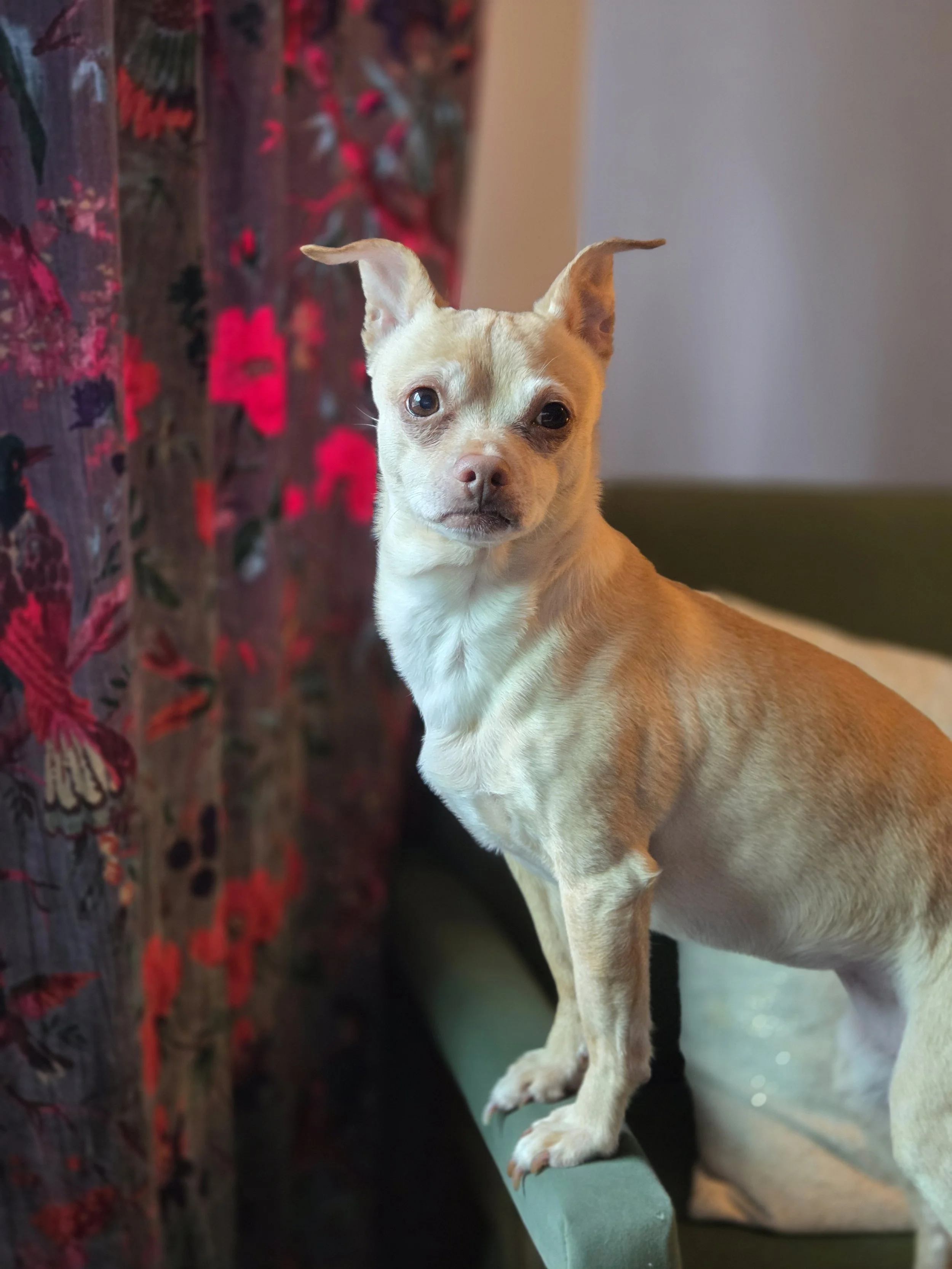
Because I provide therapy virtually from home, you may occasionally hear or see signs of real life in the background. My dog (Bunny) may bark from time to time, and my cat (Tiger) sometimes makes a quiet appearance.
I do my best to minimize interruptions, and therapy with me remains private, focused, and intentional. I like to acknowledge this upfront so you know what to expect. If occasional background pet noise feels like it would be hard for you, we can talk about whether telehealth with me feels like the right fit. I’m always happy when your pets want to say hi as well.